people management icon
People Management

Essential people management skills to build effective teams

Making the leap from being an individual contributor to managing a team is an exciting step forward in your career, but it also presents new challenges. The things that made you successful in your previous role aren’t necessarily the ones that’ll make you an effective manager. To start, you need to adopt a new way of thinking about your work. Transitioning to a manager mindset means recognizing that your success is now linked to your team’s collective results, rather than your individual output alone. You’ll also need to develop a new set of people management skills focused on things like setting clear goals for your team; encouraging a culture of learning and open communication; and proactively building relationships with senior leaders and peers across your organization. This will make you an effective and impactful manager, setting you and your team up for success.
January 22, 2026
6-minute read

Why people management skills matter

Effective people management is the single most powerful way to boost your team’s overall performance, and also has a tangible impact on an organization’s success. Research1 into Google sales teams revealed that:

  • Teams with effective managers brought in 17% more revenue than their targets.
  • Conversely, teams with ineffective management fell short of their goals by up to 19%.

That’s why people management skills are valued across every industry, from startups to global organizations, and why developing your management skills makes you more valuable to any business. The Google People Management Essentials course is designed to help new managers become more effective, based on decades of Google research analyzing millions of data points to uncover what truly makes a manager successful. Let's look at why these foundational skills are so important for a new manager's success.

Setting team goals and expectations

One of your key roles as a manager is to keep your team aligned, motivated, and moving in the right direction. To do this, you’ll need to provide:

  • Clarity: Ensure everyone understands their specific role and what is expected of them.
  • Meaning: Help team members connect their daily work to what they personally value.
  • Impact: Ensure the team can see how their contributions help the organization achieve its goals.

This involves:

  • Clearly defining your team’s goals: Using the SMART Goal framework (Specific, Measurable, Attainable, Relevant, and Time-bound) can help turn an abstract objective into a concrete and actionable goal. For example, instead of “increase sales,” a SMART goal would be: "Increase new enterprise sales revenue by 15% by the end of the year through additional outbound calls".

  • Explaining how tasks contribute to overarching objectives: When team members understand the “why” behind their tasks, it helps them see the direct link between their daily tasks and tangible business outcomes. This emphasizes the value of their work and can help them prioritize their own work more effectively.

  • Helping team members understand their individual tasks: When each contributor understands what they are responsible for, it improves accountability and helps prevent overlap.

Giving effective feedback and handling difficult conversations with employees

Being able to communicate feedback clearly and constructively is a foundational management skill. To illustrate this, let’s focus on two specific scenarios. First, we’ll explore a useful framework for providing feedback, and second, we’ll review how to turn difficult conversations into growth opportunities.

Giving effective performance feedback

Foundational management requires providing specific, actionable feedback. Both performance feedback and difficult employee conversations succeed when managers stay objective and supportive.

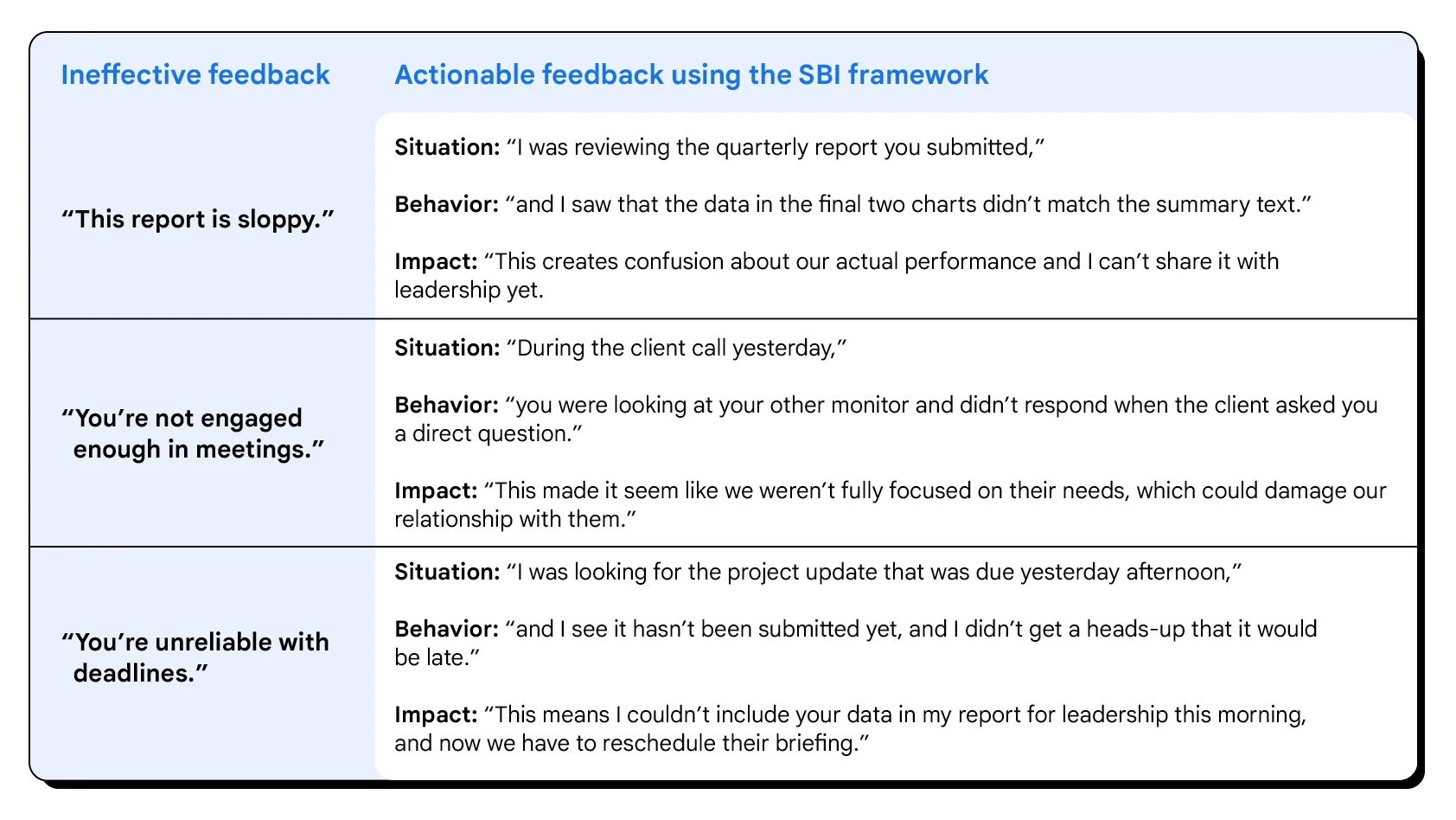
One way to structure good feedback is to use a framework like the Situation-Behavior-Impact (SBI) model.™

Start by addressing the specific situation, then describe the person’s observable behavior, and finally, explain the impact of that behavior. This helps make conversations more objective and helpful, building trust by removing judgement and creating a supportive environment where your direct reports know you’re invested in their growth. Here are a few examples of how you could restructure generic feedback into something more constructive:

Turning difficult conversations with employees into growth opportunities

Difficult conversations can help you build a stronger team. While they might feel awkward at first, having these talks as soon as problems arise helps build trust and stops small issues from turning into big ones. Over time, these interactions become important opportunities to help your team improve and to hone your management skills

Directly addressing a performance issue is only the starting point; the true value of the conversation comes with the shift toward actionable solutions. After clearly stating the problem, asking empathetic questions like “What can we do to ensure this doesn’t happen again?” and “What support do you need from me?” can help turn a difficult conversation into a constructive planning session, motivating direct reports, and driving real team development.

Coaching for employee and team development

Think of coaching as an investment in your team’s future. While providing a quick solution might solve a problem today, coaching can help your team to independently solve a hundred problems tomorrow. By asking insightful questions rather than giving instructions, you help the team build the skills and confidence they need to navigate challenges on their own.

The secret to a successful coaching conversation lies in how you listen and respond, including these core steps:

  • Asking “Powerful Questions": Use open-ended phrases like "What have you tried so far?", “What approaches could you consider?”, or "Tell me more" to spark creative thinking.

  • Reflecting and Repeating: Summarize what you’ve heard and ask, "Do I have that right?" This acts as a mirror, helping the team member see their own ideas with more clarity.

  • Embracing the Silence: Don’t rush to fill quiet gaps. Giving someone a few extra seconds to process shows you value their perspective and creates space for their own "aha!" moments.

Always wrap up the conversation by asking what they think the best next step is. This helps the team become the experts and creates a sense of pride and ownership that simply doesn't happen when they are just following a list of instructions

Creating a high-performing team environment

A positive team culture can help set your team up for success. Good managers invest time in building this environment by developing one-on-one relationships, promoting open communication, and creating a culture of learning, not blame. By understanding team members beyond their job title, you can better align the team’s work with what drives and inspires them. Actively welcoming feedback and diverse opinions demonstrates your commitment to finding the best possible solutions. When mistakes do happen, framing them as learning opportunities, rather than who is to blame, builds an environment where the team can pursue continuous growth, helping drive stronger performance.

Shifting to a manager mindset

Adopting a manager mindset requires a fundamental shift in how you think about your role. Your success is now linked more to the collective results of your entire team than your individual contributions. This means you need to prioritize helping your direct reports learn and progress in their own skills and careers, seeing their growth as one of the primary measures of your success.

As you navigate the mindset shift required to become an effective manager, you serve as a key link within the organization. You must manage down by translating strategy for your direct reports, manage up by advocating for your team’s needs with senior leaders, and manage across by building a network of support with your peers to navigate shared priorities.

To begin this journey, try asking yourself: Who leads the teams we currently work with or should be working with and how can I strengthen that relationship?

Learn more

Effective management is a skill you can learn. The key is understanding how to apply core people management skills — setting clear goals, fostering a culture of learning, and giving clear, constructive feedback— to your daily work. The Google People Management Essentials course is designed to teach you exactly that. It moves beyond theory to provide practical, actionable frameworks to help you manage your team confidently and effectively from day one.

1See Google re:Work’s guide on following the data behind great managers for more details.