How to Achieve Product-Market Fit: A Guide for Aspiring Indian Entrepreneurs
Startup School Team | October 2024
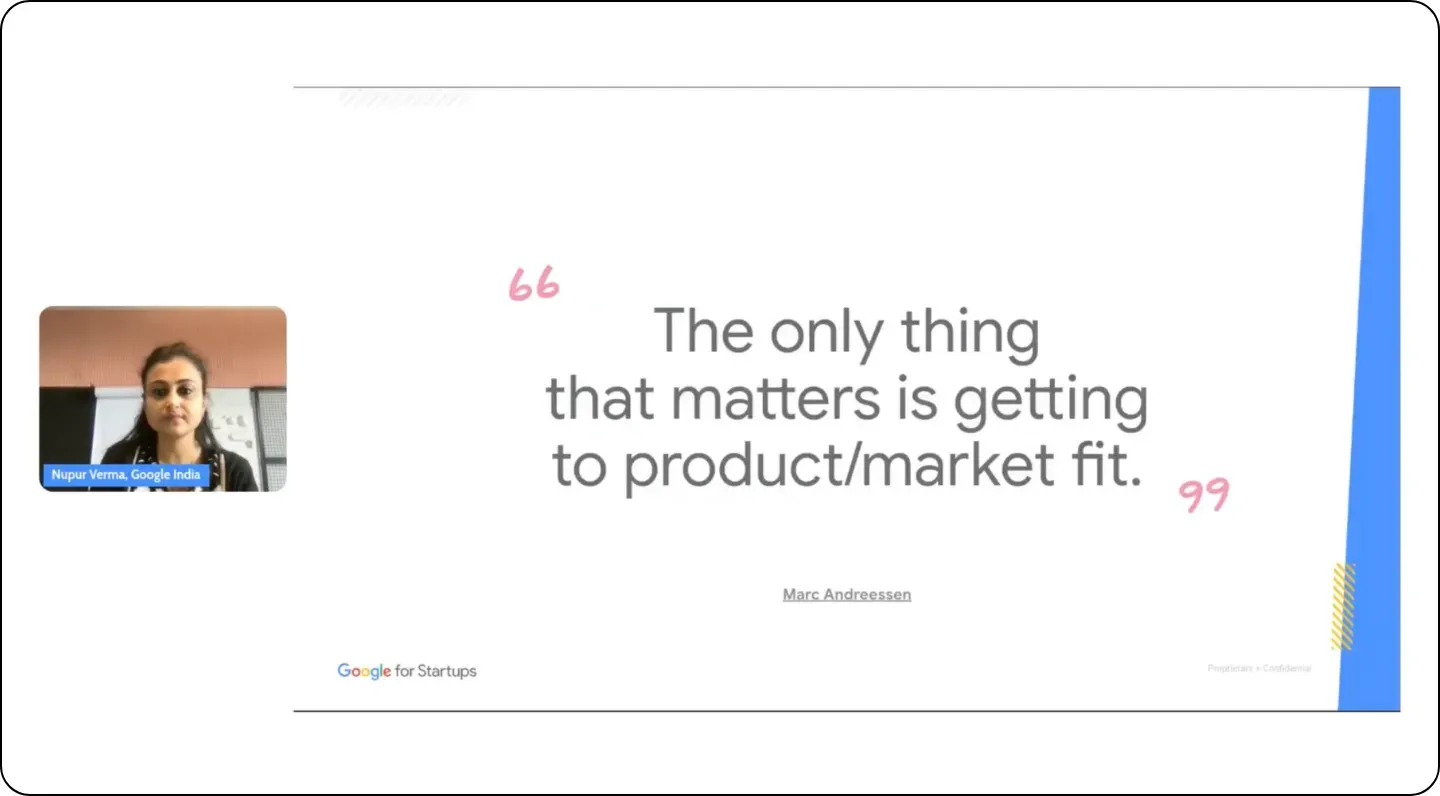
(Google for Startups India’s AI Startup School: From Market Insights to Product-Market Fit)
In India’s competitive startup ecosystem, achieving product-market fit (PMF) is the key to long-term success. It’s the moment when your product not only meets a market need but does so in a way that customers love and are willing to pay for. While getting there can be challenging, with the right mix of customer empathy, experimentation and strategy, you can succeed in carving out a space in the market.
This guide is based on the insights shared by industry leaders in two key sessions from Google for Startups India’s AI Startup School: Product Strategy: Building Products Users Love and From Market Insights to Product-Market Fit.
Consider joining Google for Startups India’s AI Startup School to explore more best practices and strategies for driving your startup's success.
1. Build with customer empathy
PMF begins with a deep understanding of your customers. This means knowing more than just who they are—you need to grasp what problems they’re facing and how your product can solve them. In India’s diverse market, addressing specific needs is crucial.
As Lalitha Ramani, general manager for Google Maps Experiences, India, Brazil & Japan, explains, “it all starts with deep customer empathy. You have to gain firsthand knowledge into the customer's needs, the pain points, and have a passion for getting close to the customer”. By directly engaging with customers, you gain clarity on their pain points, allowing you to design solutions that truly resonate.
Actionable steps:
- Have conversations: direct discussions with your customers will reveal insights that surveys alone can’t provide.
- Segment your market: break down your target audience by region, culture, and economic status to better meet their needs.
Programs like Google for Startups India’s AI Startup School offer practical tools to help you refine your customer research skills and discover what truly matters to your audience.
2. Create a clear product differentiation
Product differentiation begins with understanding and addressing your customers' unique needs while setting your business apart from competitors.
Anirudh Arun, Co-founder and CEO of BluSmart fleet offers a powerful example of this in the ride-hailing sector, “when we started back in 2019, there were already two large players who had pretty much cornered the Indian market. But we saw pain points that weren’t being addressed—like unclean cabs, cancellations by drivers, and safety concerns. We focused on solving these issues and realized there was an opportunity to create a differentiated experience in terms of reliability, hygiene, and safety”.
3. Align strategy with execution
Great ideas need solid execution to succeed. To move from differentiation to action, establish guiding principles that help inform decision-making, especially when resources are limited. This ensures that your team stays aligned and focused even when challenges arise.

Once you decide what the mainstay of your business is, focus a disproportionate amount of energy on safeguarding it. This will impact the largest portion of your consumer base.
Differentiating your product through consistent execution on core offerings can give you an edge over competitors who fail to deliver consistently.

(Google for Startups India’s AI Startup School: Product Strategy: Building Products Users Love)
4. Balance core functionality with innovation
Achieving product differentiation requires balancing core functionality with innovation. Your product must first solve a real problem before expanding into new features or ideas. It’s about finding the right balance between delivering on your product’s promise and innovating to stay ahead of competitors.
Arun provides another example from BluSmart: “in 2019, we decided to create a reliable scheduling product that did not exist in India. That remains core today, and we continue to improve on it while also building adjacent features like recurring schedulers”. By focusing on core functionality while fostering innovation, you create unique value that differentiates your product and sets it apart from competitors in the market.
5. Iterate, experiment, and adapt
Achieving PMF is rarely a straight line. It requires ongoing iteration and experimentation. As Arun notes, “there is a lot of experimentation, iteration, and validating assumptions as you execute. It’s crucial to be nimble and make adjustments along the way”.
Your approach should be to test, learn, and adjust. Listen closely to customer feedback, make changes, and test again. This iterative process will help refine your product until it meets market demands and differentiates from other products through continuous adaptation.
6. Measure what matters
Data should drive your decision-making as you approach PMF. Tracking both quantitative metrics (e.g., revenue, customer acquisition) and qualitative feedback (e.g., customer satisfaction) is essential for gauging how well your product is resonating with your audience.
Look at all available sources to measure user satisfaction—app store reviews, feedback reports, and surveys are all crucial. You need to continuously ask: Is the product delivering the value for which the customer hired it?
7. Leverage technology to accelerate PMF
In today’s tech-driven world, leveraging technologies like AI, IoT, and machine learning can greatly enhance your product’s efficiency and user experience.
Arun explains how BluSmart uses technology to predict customer needs: “we use telematics and machine learning to assign cars intelligently based on customer behavior and the car’s state of charge, ensuring a seamless experience”. By integrating emerging technologies into your product, you can stay ahead of competitors and offer solutions that are more aligned with modern consumer expectations.
8. Tailor your approach to regional differences
India’s diverse market demands a localized approach to product development. Entrepreneurs face unique challenges from regional differences in language and culture to varying levels of digital literacy and purchasing power. Your product must reflect these factors to succeed.
Ramani notes, “India’s vast market, with its diverse needs, posed a unique challenge. We knew that serving India meant developing localized solutions. For example, we introduced two-wheeler mode and offline mode in Google Maps specifically for India.”
Final thoughts
Achieving product-market fit is a journey that requires deep customer understanding, a clear product vision, and constant iteration. As you move forward in your entrepreneurial journey, remember these key steps:
- Understand your customers deeply
- Create a clear product differentiation
- Align strategy with execution
- Balance core functionality with innovation
- Continuously iterate based on feedback
- Measure progress with data-driven insights
- Leverage technology to enhance your product
- Tailor your approach to the unique challenges of the Indian market
Arun advises, “Strong convictions, lightly held—you need to be sure of your product, but humble enough to pivot when needed”.
For more comprehensive guidance, consider joining Google for Startups India’s AI Startup School to fast-track your journey to PMF and build a successful startup.
Startup School Team | October 2024
Related articles
-
AI for Indian Entrepreneurs: How AI Can Supercharge your Startup’s Success
Explore AI-powered business and startup ideas in India. Learn how AI boosts success in key sectors. Insights from Google for Startups India’s AI Startup School.
-
AI skillsets, career paths, and talent requirements for tech startups
Discover essential AI skills, career paths, and job opportunities in India's tech startups. Learn what AI roles are in demand and how to build your artificial intelligence career.